AM vs FM Radio: Complete Guide to Differences, Advantages & When to Use Each
 Berserkerus, CC BY-SA 2.5, via Wikimedia Commons
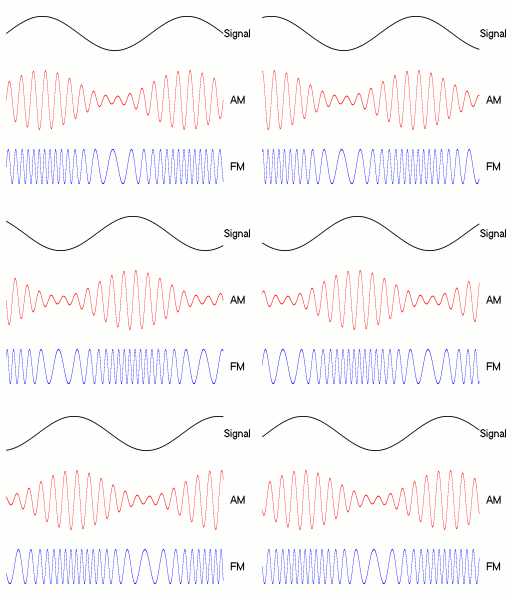
Illustration of how radio waves are modulated using amplitude modulation (AM) and frequency modulation (FM)
Berserkerus, CC BY-SA 2.5, via Wikimedia Commons
Illustration of how radio waves are modulated using amplitude modulation (AM) and frequency modulation (FM)
If you ever grew up spinning the sometimes stubborn little tuning knob instead of tapping a glossy touchscreen, you'll remember the quiet thrill of stumbling across both AM and FM stations. FM generally sounded clearer and more polished, while AM could fade or pick up bits of interference, especially during bad weather. But despite these differences, both had their own appeal, and discovering what would come through the speaker next was part of the experience.
In a world now overflowing with apps, podcasts, and algorithms that claim to know our taste better than we do, it is easy to assume that traditional radio has faded into the background. But AM and FM have endured, not out of nostalgia alone, but because of their remarkable reach, resilience, and the beautifully simple engineering tucked behind those two familiar bands.
 S. Gordon Taylor, Public domain, via Wikimedia Commons
A 1925 TRF (Tuned Radio Frequency) radio being tuned — an example of early broadcast receivers.
S. Gordon Taylor, Public domain, via Wikimedia Commons
A 1925 TRF (Tuned Radio Frequency) radio being tuned — an example of early broadcast receivers.
Before we dive into the specifics, let's tune our minds back to that invisible landscape of signals — a world quietly pulsing above our heads, that has kept us informed, entertained, and oddly comforted for more than a century. What started as a scientific curiosity became one of humanity's most democratic technologies, capable of connecting villages, cities, and entire nations with nothing more than air, electricity, and imagination.
What Do AM and FM Actually Mean?
At the heart of radio is a simple but clever idea called modulation. It's the method engineers use to imprint sound onto a radio wave — known as a carrier wave — so it can travel across towns, cities, or entire countries.
AM stands for Amplitude Modulation FM stands for Frequency ModulationPut in everyday terms:
- AM works by changing the height, or amplitude, of the carrier wave. - FM works by shifting the spacing, or frequency, of each wave peak.
It's a bit like sending the same message using two different techniques. AM is like varying the volume of your voice, while FM is like gently adjusting the pitch. The message still arrives, but the two techniques take very different routes to get there.
Fun Fact: Why Some Radios Say AM/MW and Others Have a Separate SW Band
Many older radios labelled the button AM/MW because medium wave was the main band used for AM broadcasting. Shortwave (SW), on the other hand, sits at much higher frequencies but still uses AM modulation.
The distinction is practical: MW carries local and regional stations, while SW can reach across countries and even continents thanks to ionospheric reflection.
Quick Explanation: AM, MW, SW — and What Modulation Actually Means
Before going further, it helps to understand what modulation is.
A modulation technique is simply the method used to place audio onto a radio wave so it can be transmitted. Think of the radio wave as a blank carrier. Modulation "writes" the sound onto that carrier so it can travel.
#### Why we need modulation
An unmodulated radio wave carries no information.
Modulation allows sound to "ride" on a radio signal, travel over distance, and be turned back into audio by a receiver.
Without modulation, broadcasting would not exist.
Now the terminology becomes clearer:
- AM (Amplitude Modulation) — the technique - MW (Medium Wave) — a frequency band where AM is commonly used - SW (Shortwave) — another band, also using AM, but capable of long-distance reach
In short: AM is how the sound is encoded. MW and SW are where that signal sits on the spectrum.
Where AM and FM Actually Live on the Spectrum
It helps to separate modulation methods from frequency bands:
Modulation Methods- AM - FM
Frequency Bands- LW (Long Wave) - MW (Medium Wave) - SW (Shortwave) - VHF (Very High Frequency) — where FM broadcasting is found - UHF and beyond
#### How they fit together in broadcasting
AM broadcasting commonly operates on:
- LW (in some countries) - MW - SW
FM broadcasting operates on:
- VHF, typically 88–108 MHz
In a nutshell- AM = a modulation technique used on MW, SW, and LW - FM = a modulation technique used on VHF (88–108 MHz) - MW and SW are not types of FM — they are AM-based frequency bands
Note: UHF and higher bands aren't used for AM or FM broadcasting; they carry services such as TV, mobile networks, and Wi-Fi.So What's the Difference Between MW and SW?
| Feature | MW (Medium Wave) | SW (Shortwave) |
|---|---|---|
| Frequency Range | Roughly 530–1700 kHz | Roughly 3–30 MHz |
| Modulation | AM | AM |
| Typical Coverage | Local to regional | Regional to global |
| Propagation | Groundwave by day; limited skywave at night | Strong skywave, excellent long-distance capability |
| Best For | News, talk, local broadcasts | International services, remote areas, hobby listening (DXing) |
- MW is AM for nearby and regional listening. - SW is AM for long-distance communication.
The Origins: From AM's First Broadcasts to FM's High-Fidelity Era
AM was the first major step forward in radio broadcasting, becoming the method that finally made it possible to transmit real voices and music in the early 1900s. For the first time, families could sit at home and listen to news reports, public speeches, and live performances happening far beyond their town or city. The sound quality wasn't flawless, and interference was common, but the idea itself changed communication forever.
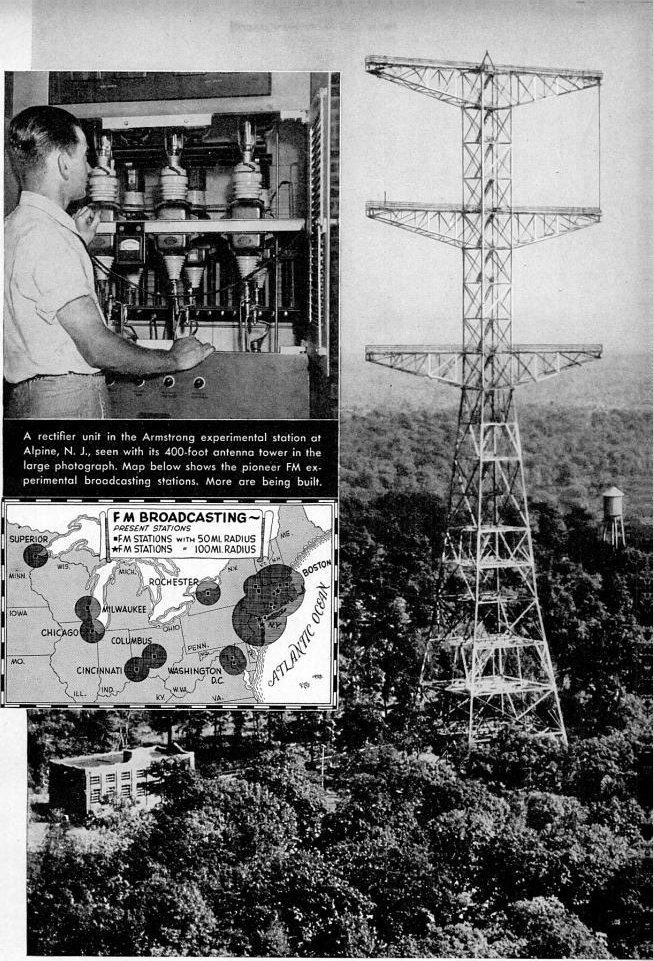
In the 1930s, American engineer Edwin Howard Armstrong introduced something new: Frequency Modulation, or FM. His research showed that by changing the frequency rather than the strength of a radio signal, much of the interference that affected AM could be reduced or eliminated. The result was noticeably cleaner and more reliable audio, especially for music.
 E. W. Murtfeldt, Public domain, via Wikimedia Commons
Edwin Armstrong's experimental FM station in 1938
E. W. Murtfeldt, Public domain, via Wikimedia Commons
Edwin Armstrong's experimental FM station in 1938
As broadcasting developed through the mid-20th century, AM and FM naturally settled into different roles. AM became the home of news, talk programmes, sports commentary, and long-distance coverage. FM, with its wider bandwidth and clearer sound, became the preferred choice for music stations and listeners who wanted higher fidelity.
Quick FAQ: Was Shortwave Before AM? And How Does It Fit In?
Was shortwave an earlier technology than AM? No. Shortwave isn't a separate technology. It's simply a range of frequencies within the radio spectrum. Shortwave broadcasts actually use AM modulation, just at higher frequencies that travel farther. So what came first: AM or FM? AM arrived first in the early 1900s and became the foundation of early broadcasting. FM appeared in the 1930s when Edwin Armstrong introduced a cleaner, more interference-resistant method. Did shortwave ever replace AM? Not really. Shortwave expanded AM broadcasting to long distances, especially for international services, but it never replaced AM on medium wave. They simply served different purposes.The Science Behind the Waves
Every radio station sits on a specific slot in the spectrum, known as a frequency. These frequencies are measured in kilohertz (kHz) for lower bands and megahertz (MHz) for higher ones.
| Type | Frequency Band | Typical Range | Audio Bandwidth |
|---|---|---|---|
| AM (Amplitude Modulation) | 530–1700 kHz | Up to roughly 100–500 km | 5–10 kHz |
| FM (Frequency Modulation) | 88–108 MHz | Around 30–50 km, depending on line-of-sight | 15–20 kHz |
How They Travel Around the World
 ja:User:Sanjo, CC BY-SA 3.0, via Wikimedia Commons
NHK Kagoshima FM transmitting tower (Japan), an example of FM broadcast infrastructure
ja:User:Sanjo, CC BY-SA 3.0, via Wikimedia Commons
NHK Kagoshima FM transmitting tower (Japan), an example of FM broadcast infrastructure
AM signals have an unusual advantage: they can travel extremely long distances, especially at night. This is due to a phenomenon called skywave propagation, where the signals reflect between the ionosphere and the Earth's surface. Because of this, an AM station broadcasting in Delhi can sometimes be heard hundreds of kilometres away once the sun goes down.
FM behaves very differently. FM stations operate at much higher frequencies, and these signals tend to move in straight lines, known as line-of-sight transmission. They do not bounce off the ionosphere; instead, they pass straight through it. This limits their range but provides stable, clear reception within the coverage area.
The Sound Quality Factor
When it comes to sound, FM generally takes the lead. Because FM changes frequency rather than amplitude, it is far less affected by electrical interference from things like lightning, motors, or power lines. This is why FM stations usually sound cleaner and more consistent, even when you're moving.
AM works differently. Since it varies the strength of the signal, it is more vulnerable to outside noise, which can create that familiar buzzing or fading effect you hear when driving past overhead cables or in stormy weather.
FM also offers stereo sound, a wider dynamic range, and lower distortion, making it well suited to music and detailed audio. AM, by contrast, is limited to mono and a narrower bandwidth, but it handles speech extremely well. That is why AM remains a practical choice for news, talk programmes, and many types of long-range broadcasting.
Weather, Terrain, and Distance
Weather plays a bigger role in AM reception than many people realise. Thunderstorms, in particular, release sharp bursts of electromagnetic energy that AM radios pick up as noise or static. FM, operating at much higher frequencies, is far less affected by this type of interference.
What FM does struggle with is the landscape. Mountains, tall buildings, and dense urban environments can block or weaken FM signals because they travel in straight lines. This is why hilly regions or large cities often rely on repeaters or relay stations to keep coverage consistent.
AM is more forgiving in this respect. Its longer wavelengths can travel across wide areas and follow the curvature of the Earth, often allowing a single powerful transmitter to cover an entire region, especially in flat terrain.
Power Consumption and Transmission Costs
FM transmitters typically use more power, largely because they operate at higher frequencies and need wider bandwidth to deliver their sound quality. This makes FM excellent for clarity, but it does mean higher running costs for broadcasters.
AM, on the other hand, often relies on very tall antennas and high-voltage equipment to send its long waves over large distances. The hardware can be substantial, but once everything is in place, AM remains relatively inexpensive to operate, especially when the goal is to cover large regions with basic audio.
In practical terms, AM is still the cheaper option for wide-area communication where fidelity is not the priority, such as emergency alerts or rural broadcasting. FM tends to cost more per kilometre of coverage, but it provides noticeably better sound within its intended local footprint.
The Listening Experience
Turn a radio dial and you'll quickly notice the difference in what each band tends to offer. AM stations usually focus on news, talk programmes, sports coverage, and other speech-based content. FM stations, with their clearer audio, are the home of music, local entertainment, and community-focused shows.
FM gives you a fuller, more detailed listening experience, but AM has the advantage of reach. An AM signal can be heard far beyond city limits, stretching across open countryside, deserts, or even well out at sea. That reliability is why travellers, long-distance drivers, and people stationed far from major towns often rely on AM when FM begins to fade.
Technical Advantages: AM vs FM
| Feature | AM | FM |
|---|---|---|
| Signal Range | Long (often hundreds of kilometres) | Shorter (usually a few dozen kilometres) |
| Sound Quality | Lower, mono | Higher, stereo |
| Resistance to Noise | Low | High |
| Bandwidth Required | Narrow | Wide |
| Transmission Cost | Generally low | Moderate |
| Antenna Size | Large | Smaller |
| Best For | News, talk, alerts | Music, entertainment |
AM and FM in the Age of Satellites and Internet
With so much attention on streaming platforms and internet radio, it is easy to assume that traditional broadcasting is losing relevance. And you might think radio's days are numbered, yet even in 2025, AM and FM remain central to how much of the world communicates. To understand how these formats are distributed globally, explore our comprehensive global radio landscape across all 195 countries.
FM continues to thrive in everyday life. It is still the default choice in cars, kitchens, shops, and even many smartphones, which quietly include FM chips for local listening. AM, meanwhile, plays a crucial role in areas where long-range coverage matters most. It underpins many emergency networks and remains important in aviation and maritime communication, where reliability is essential.
 B.G.Wilson121, CC BY-SA 4.0, via Wikimedia Commons
WIUP-FM college radio station in Indiana, Pennsylvania (example of a local FM broadcast station)
B.G.Wilson121, CC BY-SA 4.0, via Wikimedia Commons
WIUP-FM college radio station in Indiana, Pennsylvania (example of a local FM broadcast station)
When digital services go down, whether because of network failures or extreme weather, broadcast radio keeps working. It does not depend on data, towers, or satellites. It simply carries on — immediate, resilient, and accessible to anyone with a basic receiver.
When to Use Each
AM is the practical choice when distance matters. Its long reach makes it suitable for rural broadcasting, disaster communications, and certain forms of aviation navigation where reliable coverage is essential.
FM comes into its own when sound quality is the priority. Local stations, music-led programming, live events, and community broadcasting all benefit from the clarity and wider audio spectrum that FM provides.
In practice, many broadcasters use both. AM delivers reach; FM delivers richness. Together, they create a balance that continues to serve audiences well. Learn more about radio around the world and how different countries balance these technologies.
A Bit of Fun: Why FM Sounds "Fuller"
The Science of SoundThe reason FM feels clearer or "fuller" isn't a trick of the ears... it's Physics. It comes down to bandwidth. FM can carry far more audio information per second than AM due to its wider bandwidth, which allows it to reproduce a wider range of frequencies — from low bass notes to crisp high tones, without the distortion that often affects AM.
This extra room in the signal is what gives FM its clean, modern character, especially when playing music. It also explains why FM helped shape the hi-fi movement of the 1960s. For the first time, broadcasts could do justice to the detail found in vinyl records and live performances, and listeners quickly noticed the difference.
The Battle of the Bands: AM Revivals & FM Futures
In some parts of the world, AM services are gradually being retired and replaced with digital platforms. Yet in many developing regions, AM still plays an essential role. Its wide coverage makes it a dependable source of news, educational programming, and emergency information for communities that may not have stable internet or local FM networks.
FM, meanwhile, has continued to adapt. Features like RDS (Radio Data System) allow stations to broadcast song titles, station names, and basic data such as traffic or weather updates alongside the audio. These additions have helped FM remain relevant even as digital technologies grow.
Digital successors or the Digital radio formats such as DAB (Digital Audio Broadcasting) have become widespread in parts of Europe and Australia, offering more stations and clearer audio. Even so, FM maintains a strong presence. Its simplicity, reliability, and compatibility with millions of existing receivers ensure that it remains part of everyday listening.
A Tale of Two Technologies
AM and FM were never meant to compete; they simply emerged at different points in radio's development and ended up serving different purposes. AM carried many of the first major broadcasts of the 20th century — early news reports, wartime announcements, public events, and the voices that helped define modern communication.
FM arrived later with a different goal: to improve sound quality. It quickly became the preferred choice for music and programmes where clarity and detail mattered most.
Together, these two technologies shaped how people received information and entertainment for generations. They helped make radio one of the most influential tools of the last century, long before digital platforms arrived.
The Future Dial
Even as streaming services and digital platforms dominate today's conversations about audio, traditional radio continues to hold its place. AM and FM have never aimed to compete with the internet; instead, they exist alongside it, offering a dependable alternative that does not rely on data networks or complex infrastructure.
In situations where online services fail — whether due to outages, emergencies, or simple coverage gaps — broadcast radio remains one of the most reliable ways to share information. As long as a receiver is switched on, the signal will be there. It is a reminder that some technologies stay relevant not because they are old, but because they remain resilient and accessible to everyone.
"AM and FM were never meant to compete; they simply emerged at different points in radio's development and ended up serving different purposes."---
Last reviewed for accuracy: 2026.
---
References & Sources
1. Federal Communications Commission (FCC) – AM vs FM Technical Comparison 2. BBC Transmission Engineering Archives – FM Development & History 3. NASA Earth Observatory – Radio Wave Propagation 4. ARRL Handbook 2024 – Radio Modulation Techniques 5. Encyclopaedia Britannica – Amplitude and Frequency Modulation 6. Armstrong, E. H. – The Invention of FM Radio (1933 patent) 7. ITU-R – Radio Regulations and Frequency Allocations
---
Which do you prefer — the long reach of AM or the rich sound of FM? Have you ever caught a distant AM station at night, or discovered a local FM gem? Share your radio memories with us!