The Fascinating History of Radio Broadcasting: From Wireless Whispers to Modern Radio
 Austin C. Lescarboura, Public domain, via Wikimedia Commons
The Invisible Symphony
Long before radio stations filled the air with music and stories, researchers discovered something surprising: the air wasn't empty. It could carry signals, patterns, and messages, a silent rhythm waiting to be heard. Once people learned how to read those invisible waves, a new form of communication was born. This is the story of radio broadcasting - a tale that begins with sparks, travels through wars, dances with music, and still thrives today in podcasts and digital streams.
Chapter 1: The Birth of the Spark - Early Pioneers
Before "radio" was even a word, inventors were tinkering with a mysterious force: electromagnetic waves.
The Theory: James Clerk Maxwell (1860s)
 Unidentified photographer. Smithsonian Institution from United States, Public domain, via Wikimedia Commons
Maxwell predicted the existence of electromagnetic waves, the invisible foundation for all wireless communication. His equations described how electric and magnetic fields dance together, creating ripples that can travel endlessly through space.
Long before anyone could see or detect such waves, he imagined a universe where light itself was just another form of electromagnetism… a breathtaking unification of physics.
He didn't build radios, but he laid the mathematical bricks for others to walk on… a theoretical map that would one day guide Hertz, Bose, and Marconi in turning invisible forces into human connection.
The Proof: Heinrich Hertz (1886)
 Klaus-Dieter Keller, Public domain, via Wikimedia Commons
Hertz proved Maxwell right. He built an apparatus that generated and detected these invisible waves. The "spark-gap transmitter" sent out radio waves, and a metal loop nearby picked them up, crackling with little sparks of its own. That was the first wireless signal ever received.
In that quiet lab, he had just opened a new chapter in physics - waves leaping through the air, unseen yet real. But Hertz wasn't thinking of communication; for him, it was simply a brilliant physics experiment. He once admitted he couldn't imagine any practical use for it. Little did he know, those tiny sparks would one day power the world's greatest connections.
The Scientist and Architect of Wireless Communication: J C Bose (1890s)
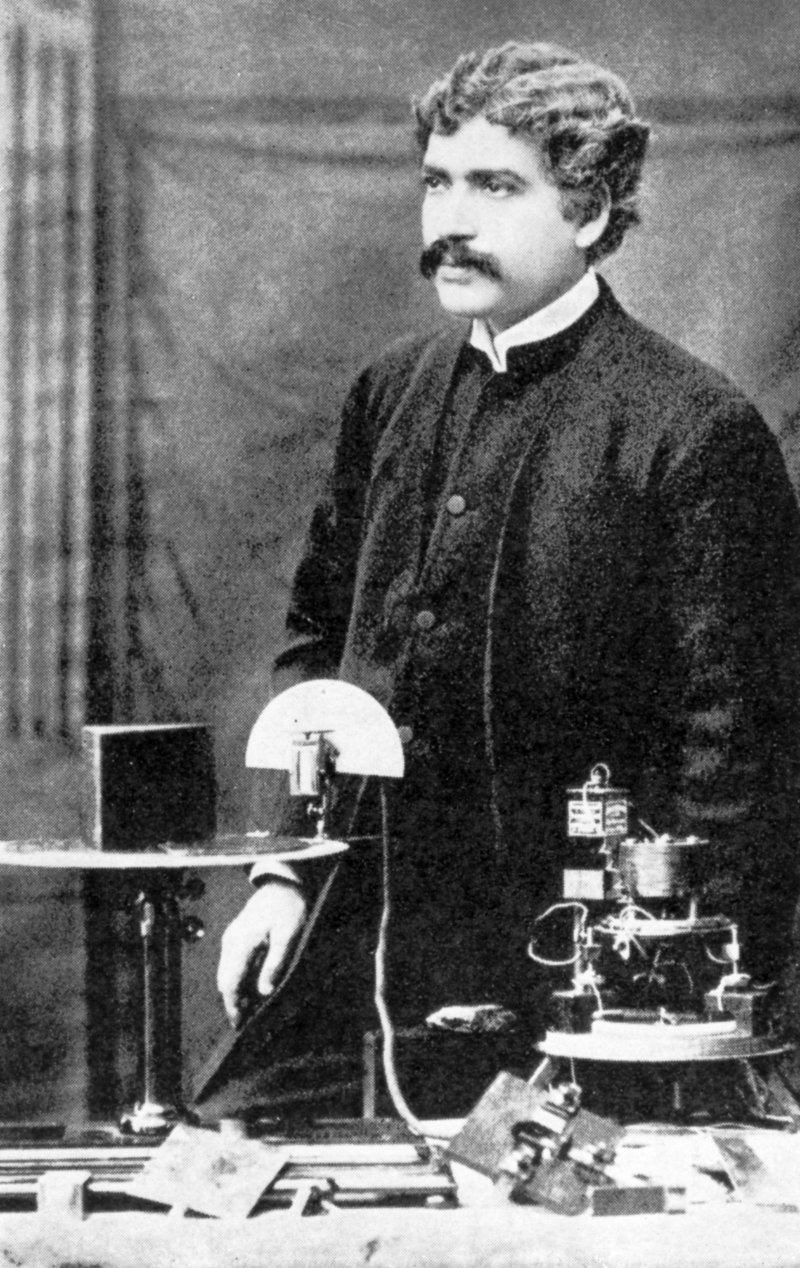 The Birth Centenary Committee, printed by P.C. Ray, Public domain, via Wikimedia Commons
At the turn of the century, a quiet genius from India, J. C. Bose, stepped in with pioneering experiments that reshaped our understanding of wireless communication.
In early 1894, Bose began experiments demonstrating the generation and detection of radio waves at Presidency College, Calcutta. In November 1894, The Electrician, a London journal, published his paper on using electromagnetic waves for experimental purposes, a publication that quietly set the scientific world alight with curiosity. By 1895, he publicly demonstrated the wireless transmission of electromagnetic waves (millimeter waves) across a hall of about 75 feet, ringing a bell and igniting gunpowder remotely... a feat that laid the foundation for modern wireless and microwave technology.
He went far beyond mere demonstration. Bose developed semiconductor detectors, waveguides, and advanced microwave components… inventions that would not reappear in mainstream electronics for several decades.
Driven not by profit but by the pursuit of knowledge, Bose refused to patent his discoveries, believing that scientific progress should belong to humanity, not to markets. Among his many innovations was the mercury coherer with telephone detector, a remarkably sensitive receiver that played a vital role in detecting radio signals and later influenced the evolution of wireless communication.
His groundbreaking research would soon pave the way for the long-distance radio technologies that followed, proving that Bose's quiet laboratory in Calcutta had already echoed with the first true whispers of wireless communication.
Fun Fact: In 1896, Bose's apparatus could transmit signals through walls - the same principle that underlies your Wi-Fi today.The Messenger: Guglielmo Marconi (1895–1901)
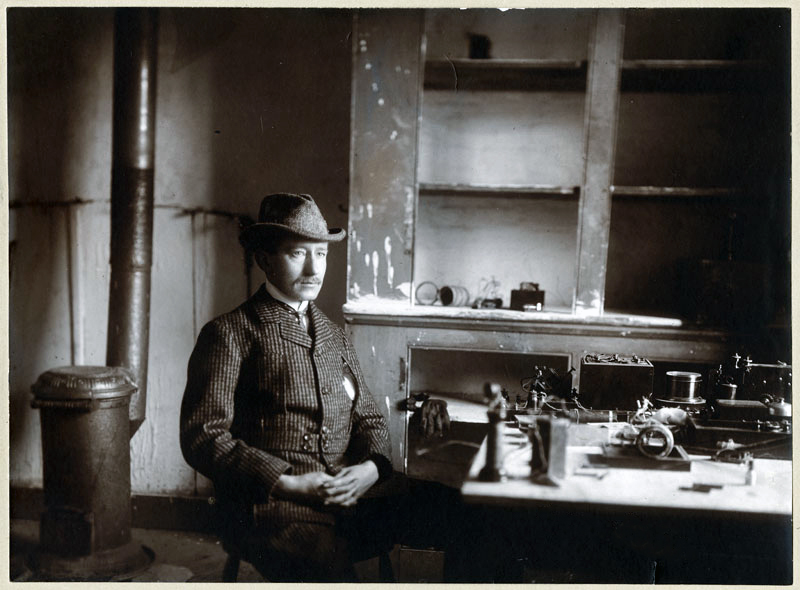 James Vey (1852?-1922), Public domain, via Wikimedia Commons
While the scientific groundwork for wireless communication had already been explored by earlier pioneers, Guglielmo Marconi transformed those insights into a global technological movement, capturing the imagination of governments, scientists, and the public alike.
In the summer of 1895, he successfully transmitted signals over a kilometer on his family estate in Italy. This achievement was made possible through his relentless experimentation with antennas, grounding techniques, and elevated transmitters, innovations he refined through trial and error. The experiment demonstrated the practical potential of radio waves at a time when even seasoned physicists remained skeptical of long-distance wireless communication.
By 1901, he achieved a historic feat: transmitting the Morse code letter "S" across the Atlantic Ocean, from England to Newfoundland. This transatlantic attempt was filled with uncertainty. His own team doubted that a signal could bend over the curvature of the Earth, and Marconi had to rely on large kite-lifted antennas to capture the faint transmission. When he finally heard the three short clicks representing the letter "S", it became one of the most defining scientific moments of the century.
Marconi's achievement was not just a technical milestone. It reshaped global communication and inspired governments and industries to invest in wireless networks. Within a few years, ships at sea, naval fleets, and weather stations began adopting radio systems based on his work. His company, the Marconi Wireless Telegraph Company, became a major force in early telecommunications.
There were also dramatic episodes that added to his legend. Marconi's wireless system played a crucial role in maritime safety, most famously during the RMS Titanic disaster in 1912. The distress calls sent using Marconi equipment helped coordinate rescue efforts and accelerated the global push for standardized wireless communication laws.
By demonstrating that wireless signals could travel across vast distances, Marconi opened the door to a completely new era of communication. His contributions marked an important phase in the growth of wireless communication and influenced the later emergence of radio, broadcasting, radar, satellite links, and the broader digital world.
And… thus began the age of radio!
Chapter 2: From Morse to Music - The Rise of Broadcast Radio
 University of Alberta Archives, Public domain, via Wikimedia Commons
At first, radio was like WhatsApp… but only for Morse code messages between ships and stations. Then came the idea of transmitting sound.
Reginald Fessenden: The First Voice (1906)
On Christmas Eve 1906, Fessenden made history. He read passages from the Bible and played a violin solo over the airwaves.
Imagine sailors at sea, accustomed only to the rhythmic dots and dashes of Morse code, suddenly hearing music and a human voice. That night, radio was reborn from code to conversation.
Lee de Forest and the Audion Tube
Lee de Forest invented the vacuum tube amplifier (Audion) in 1906, making it possible to amplify weak radio signals.
Without him, your radio would've whispered instead of sang.
Chapter 3: The Golden Age of Radio (1920s–1940s)
 Elmer Eustice Bucher, Public domain, via Wikimedia Commons
Now picture the 1920s: jazz in the air, roaring automobiles, and living rooms glowing with wooden radio sets.
1920: KDKA, Pittsburgh - The First Commercial Broadcast
KDKA went on air on November 2, 1920, announcing the U.S. presidential election results.
It wasn't just news… it was magic. People heard history unfold live.
Soon, stations multiplied. Families gathered around their radios every evening, like ritual news at 7, drama at 8, music at 9.
"It's time for The Shadow... and don't touch that dial!"Music Meets the Microphone
Big bands and crooners dominated the airwaves. Jazz, swing, and early rock found their way from clubs into millions of homes.
For the first time, music became mass media.
Radio News and War
During World War II, radio became humanity's lifeline in an age of uncertainty.
Families across cities and villages gathered around the soft glow of their sets, listening for updates, stories, and voices that reminded them they were not alone. Amid fear and chaos, radio carried both truth and rumor, comfort and command. It became the invisible thread connecting the frontlines and the home front, the soldiers and the sleepless.
In those fragile moments, it wasn't about nations or leaders; it was about the power of sound to hold humanity together. War correspondents brought the battlefield into living rooms, turning radio into both a comfort and a weapon.
Propaganda too found its way onto the airwaves "Tokyo Rose" and "Lord Haw-Haw" became infamous voices during the war., shaping hearts and headlines alike. Radio had proved that words could move armies and change the course of history.
Chapter 4: AM vs FM - The Battle of the Bands
 Dsw4, Public domain, via Wikimedia Commons
As radio matured, two main technologies emerged AM (Amplitude Modulation) and FM (Frequency Modulation).
AM Radio: The Classic Workhorse
AM was first. It modulates the amplitude (strength) of the signal. It can travel long distances, even bounce off the ionosphere at night.
That's why AM stations could be heard hundreds of kilometers away… but with static and noise.
FM Radio: The Game Changer
In the 1930s, Edwin Armstrong invented FM. It varied the frequency instead of amplitude, giving clearer, static-free sound - perfect for music.
But commercial adoption was slow. AM ruled the airwaves for decades. FM rose in the 1960s and 70s when rock 'n' roll demanded better sound quality.
Did you know? The term "Hi-Fi" (High Fidelity) became a selling point during FM's rise.Chapter 5: Shortwave and the Global Voice
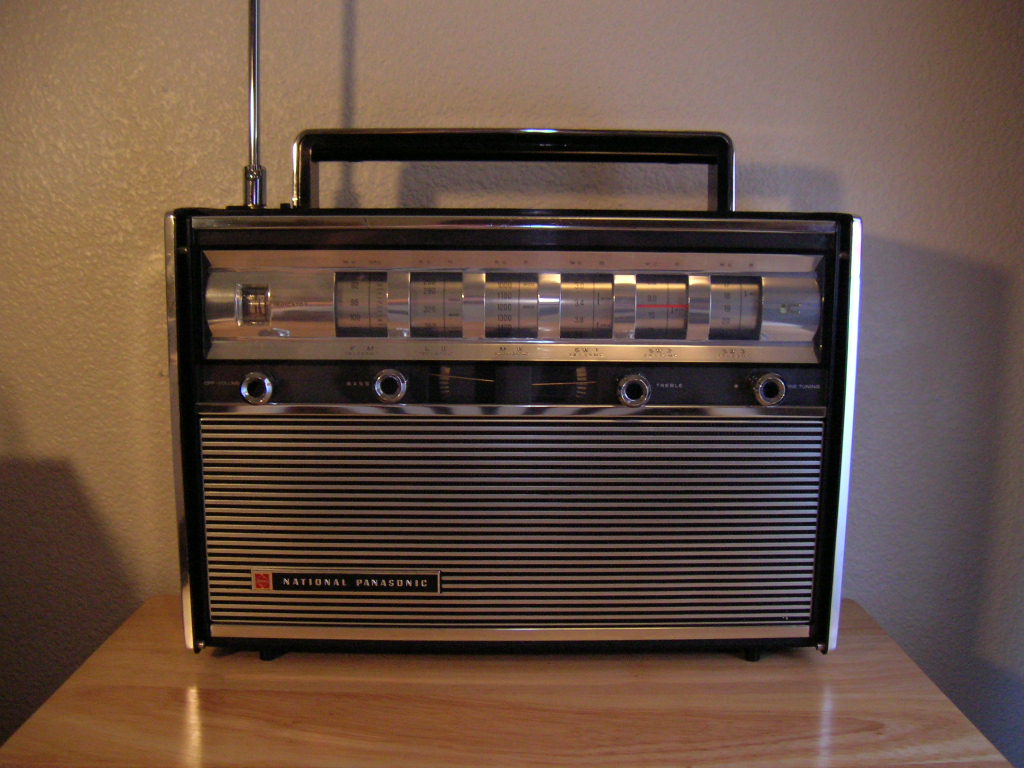 Junglecat at English Wikipedia, Public domain, via Wikimedia Commons
As the world grew smaller, radio waves reached farther.
Shortwave Radio (SW)
Shortwave operates between 3 and 30 MHz. Its unique trait? It bounces off the ionosphere, letting signals travel across continents.
That's how BBC, Voice of America, and Radio Moscow reached listeners behind political borders and Iron Curtains.
For decades, shortwave was the internet of the pre-internet era - free, global, and uncensored.
"This is London… calling the world."Even today, shortwave remains vital for remote regions, ships, and during disasters when everything else fails.
Chapter 6: The Television Invasion and Radio's Reinvention
When television appeared in the 1950s, many predicted radio's death.
But radio didn't die… it evolved.
Car Radios: The New Frontier
As cars became central to modern life, radio moved into dashboards. AM/FM became your travel companion… weather, news, and top hits on the go.
The Portable Revolution
Then came the transistor radio… small, battery-powered, and affordable.
Teenagers could carry music wherever they went.
This was radio's second golden age - personal, portable, and rebellious.
Chapter 7: The FM Boom, Talk Shows, and Niche Formats
The 1970s-1990s saw FM dominate. Stations specialized - Top 40 hits, talk shows, sports, classical, news.
Hosts became celebrities. "Drive-time" and "morning shows" became household terms.
Meanwhile, AM found a new role - news, talk, and politics.
"Good morning, America. You're listening to the Rush Limbaugh Show!"Radio had reinvented itself again - as a space for voices and opinions.
Chapter 8: From Antennas to Algorithms - The Digital Shift
As the 21st century dawned, the internet brought both threat and opportunity.
Internet Radio and Streaming
Streaming platforms like Pandora, Spotify, and Apple Music blurred the line between radio and playlist.
Anyone could create a station, no transmitter needed.
Live radio moved online - global reach, zero static. Today, broadcasters worldwide combine traditional and digital formats—discover how in our guide to radio around the world.
Podcasts: The New Radio
Podcasts revived radio's storytelling soul. True crime, interviews, audiobooks - on demand, everywhere.
What once needed antennas and towers now fits in a smartphone app.
Smart Speakers and Voice AI
Today, you can just say, "Alexa, play BBC World Service," and your voice becomes the new dial knob.
Radio has gone from spark to stream, yet its essence remains unchanged: human voices traveling invisibly across space, connecting minds and hearts.
Chapter 9: Why Radio Still Matters
 Markus Kniebes from Bochum, Germany, CC0, via Wikimedia Commons
In an age of social media noise and algorithmic chaos, radio remains human.
- It's accessible and anyone with a cheap receiver can listen. - It's intimate… a voice that talks to you, not at you. - It's resilient and works when networks fail. - It's local and global at once... your city's traffic and the world's headlines, both on the same dial.
To see how radio continues to thrive across different technologies and countries, explore the complete global radio landscape.
Even the latest digital standards DAB (Digital Audio Broadcasting) and HD Radio are just evolutions of the same timeless promise:
"To connect people through the air."The Eternal Wave
From Maxwell's invisible equations that first imagined electromagnetic waves, to Hertz's sparks that proved them real…
From J.C. Bose's silent transmissions in Calcutta, to Marconi's triumphant dots crossing the Atlantic, to Armstrong's crystal-clear FM tones, and now to your Spotify playlist… radio has never stopped evolving.
It's more than a technology.
It's a mirror of humanity's eternal desire… to speak, to listen, to connect.
And somewhere, even now, as you read this,
a faint wave travels silently through the air…
carrying someone's story to someone else's heart.
---
Last reviewed for accuracy: 2026.
---