Why Shortwave Still Matters in 2025
"When everything else fails, shortwave remains." - A common saying among emergency broadcastersIntroduction
The world today feels more connected than ever. We carry the internet in our pockets, speak into smart assistants and let algorithms tune our playlists. Yet behind the shining façade of uninterrupted connectivity lies a growing vulnerability.
Subsea cables are cut by accident or sabotage. Satellites malfunction or are hacked. Governments throttle online access during elections or uprisings. Electricity grids fail under storms or cyberattacks.
It's hard to imagine being offline in 2025. But still, say you're far from home, on a remote island or in a desert, completely outside mobile coverage, and your phone can't connect to anything. Naturally, news apps return Retry, and your social feeds stall altogether. But then, just by chance, if you have a solar- or battery-powered radio along with you, you switch it on and turn the knob to a shortwave band. You hope something may work out. And after a moment of static, you may get to hear a voice that comes through. It could be a live human signal coming from far away — that's shortwave radio.
When digital networks collapse, there is still one technology that keeps speaking. A century old voice that refuses to go silent.
Shortwave radio is still here. It still reaches where wires cannot. It still crosses borders that politics cannot seal shut. It still delivers culture and truth to those who have no other channel.
Shortwave is only short in name. Do not let that fool you. It is the longest connection humanity has ever built out of thin air. Its reach is global, and its impact is anything but small. Shortwave does not travel short distances... It carries the farthest voices and reaches where other signals fear to go.
More than a century old, shortwave is a technology many assumed would vanish with the rise of the internet. Yet here we are, in 2025... still relying on it when the digital world proves fragile. This is the story of why shortwave refuses to die, and why its role may be more important now than ever. To understand how shortwave fits into the modern radio around the world, explore its place alongside AM, FM, and internet radio. And why it may matter even more in the years ahead.
What Makes Shortwave Special
Shortwave radio occupies a range of frequencies between 1.6 MHz and 30 MHz. These signals bounce off the ionosphere and can travel thousands of kilometres, even halfway around the world, using tiny amounts of power and often with nothing more than a wire antenna.
No subscription. No infrastructure. No permission required.
Shortwave is freedom in the form of invisible waves.
How Shortwave Works (Without a Single Cable)
The Magic Bounce: Ionospheric Propagation
 NASA's Scientific Visualization Studio, Public domain, via Wikimedia Commons
Shortwave signals (3-30 MHz) travel upward and interact with the ionosphere - a charged layer of the atmosphere energized by the sun. When radio waves reach it, instead of escaping into space, the waves can refract back toward the Earth. Under the right conditions, they bounce again, forming a long-distance relay between the ground and the sky.
Confused! Here's the key: Shortwave signals can bounce again and again, like skipping a stone across water. This "sky-bounce" or leapfrogging allows a single transmitter to jump: Across mountains, Over deserts, Beyond national borders, All the way over oceans!
This allows a single transmitter in one country to reach listeners thousands of kilometers away, even multiple continents away, using only a few kilowatts of power. So a broadcast from one country can land clearly in living rooms half a world away - even where there are no cables, no cell towers, no satellites, and no local radio infrastructure on the receiving side at all.
Shortwave's reach depends on:
- Solar activity: sunspots and storms strengthen long-distance coverage - Time of day: night boosts the lower SW bands - Season and geography: paths shift with Earth's tilt - Frequency selection: broadcasters choose the best band for the target region
It's not magic. Just clever use of the planet's natural layers or call it physics doing the heavy lifting.
Side Note: Why Do Some Sources Say 1.6-30 MHz while others 3 to 30 MHz?
Technically, shortwave radio is the High Frequency (HF) band, defined as: 3 to 30 MHz
However, long-range broadcasting has historically included some frequencies just below 3 MHz - around 1.6 to 3 MHz - because at night, these signals also bounce off the ionosphere and travel far.
So while engineers stick to 3-30 MHz, many broadcasters - especially in the mid-20th century - treated 1.6-3 MHz as part of "shortwave" service for practical reasons.
In short:
- Official definition: 3-30 MHz - Broadcasting reality: ~1.6-30 MHz when long distance matters
Antennas Like Steel Curtains
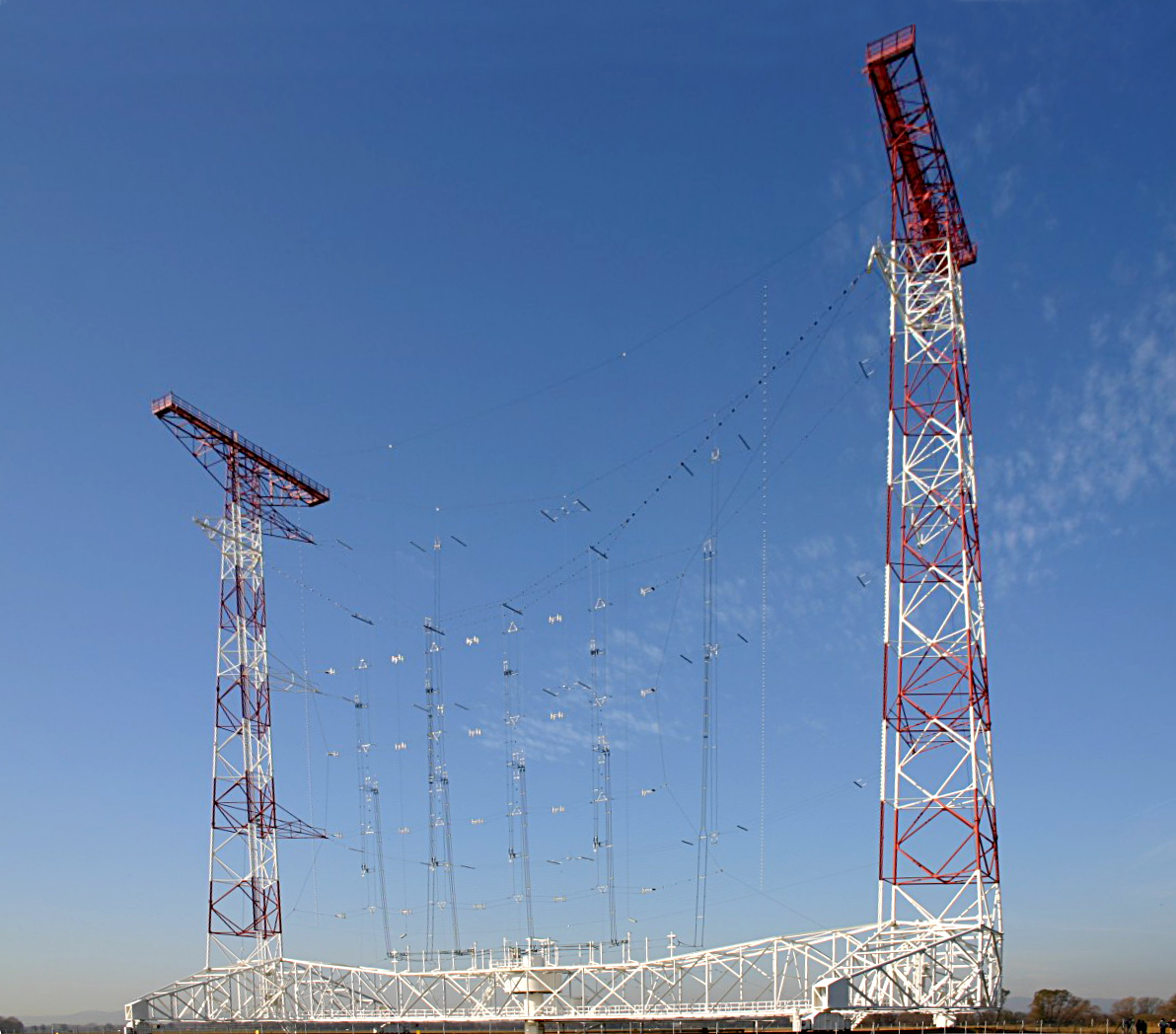 Peter Knorr, Public domain, via Wikimedia Commons
Major international Shortwave broadcasters use vast arrays of directional antennas. These steel frameworks - called curtain antennas - are suspended across tall towers like giant metallic sails.
These metal "curtains" are designed not to transmit locally but to reach the world. So, instead of broadcasting everywhere, they send focused radio beams that can cover an entire region or even a precise country thousands of kilometers away. Engineers steer signals with:
- Antenna orientation - Frequency choice - Adjustable reflector screens
Modern facilities often rotate antennas to chase audiences around the world as night and day move across the globe.
Shortwave broadcasting sites look more like power plants than media studios - and that's exactly what they are: infrastructure built to reach the planet.
Portable Receivers: A Radio in Your Rucksack
Small battery-powered radios make shortwave accessible to anyone. For most, they cost less than a meal in many countries and require no subscription or SIM card. A tiny telescopic antenna is enough to pick up signals from another continent.
This is why shortwave still matters:
- Works during blackouts and disasters - Works where networks are censored - Works in remote villages and ships at sea - Works off-grid with hand-cranks, solar panels, or AA batteries
No login. No data plan. No gatekeepers.
If you can hear the sky, you can hear the world. Even when electricity goes... a hand-crank or AA batteries keep the world talking. Shortwave is radio for everyone!
A Brief History of Shortwave: Radio for the Whole Planet
The Spark-Gap Beginnings: The Unexpected Birth of Long-Distance Radio (The Original Internet)
Early radio communication was dominated by long-wave signals. These required enormous antennas and heavy equipment, and even then the coverage was fairly limited. Engineers assumed shorter wavelengths were weak and impractical - useful only for experiments.
That changed in the 1920s when radio pioneers observed something remarkable. Shorter signals bounced off the ionosphere, traveling thousands of kilometers with minimal power. This discovery opened the door to a new era where radio transmissions could reach across oceans, connecting continents in real time.
The discovery pushed radio from a national tool to a truly international technology. Suddenly the world could hear news beyond its borders! Thus before satellites, before fibre optics, there was shortwave... the first truly global communication network.
 F1jmm, Public domain, via Wikimedia Commons
Radio as a Weapon: The Airwaves Become a Frontline
By the time World War II erupted, shortwave radio had become a strategic instrument for every major power. Governments - from colonial empires to Axis states... broadcast messages designed to shape opinion, encourage loyalty, and undermine enemies. Propaganda became as common as news, often blending together in the same transmission. The content ranged from morale-boosting messages to deliberate disinformation.
Millions tuned in secretly during blackouts or under threat of surveillance. Some listeners sought hope and clarity. Others simply tried to understand what was happening beyond their immediate surroundings.
Radio demonstrated that, in wartime, control over information could be just as critical as control over territory. Radio could uplift, mislead, or frighten, depending on who controlled the frequency. And, shortwave became a reminder that information in wartime is rarely neutral.
Voices of Freedom: Information as Power & The Battle for Truth
After 1945, shortwave entered an era defined by ideological conflict. Broadcasters such as Voice of America, Radio Free Europe, and the BBC World Service sent news into places where censorship restricted what people could know. Meanwhile, the Soviet Union, China, and other governments produced their own competing narratives.
During the Cold War, shortwave became a lifeline. Ordinary people in Eastern Europe, Africa and Asia tuned in secretly for alternative views and culture that state media tried to suppress. Millions risked punishment to hear perspectives that authorities feared. For many listeners, tuning in was an act that carried risk... yet it offered a window beyond borders and propaganda. Governments attempted to jam signals, which only proved how threatening open access to information could be.
Shortwave radio became a tool that challenged political isolation and control. Radio could not be locked behind borders.
Why Shortwave Matters More Than Ever in 2025
The modern world is more reliant on fragile networks than any time in history. Shortwave is immune to many of the weaknesses that threaten the systems we trust today.
Let us explore the five areas where shortwave proves its continuing value.
1. Emergency Communication: When Everything Else Fails
During natural disasters and conflicts, phone networks and the internet are often the first to go down. Shortwave remains the backup of last resort.
Fukushima, 2011While mobile networks were down, amateur radio operators relayed rescue information. Shortwave helped coordinate aid delivery into damaged regions.
Hurricanes in the CaribbeanEvery hurricane season, community broadcasters keep island populations informed when power and mobile masts fail. Local voices carrying life saving updates.
War Time CommunicationsShortwave carries information into blackout zones. It continues today in conflicts like Ukraine, where foreign broadcasters revived shortwave to counter internet disruptions and propaganda.
Governments may switch off networks. They cannot switch off the sky.
2. Travel, Exploration and Remote Living
Shortwave is indispensable in aviation and maritime operations. Ships in remote waters listen for weather updates. Pilots use HF radio to stay connected during transoceanic flights. Adventurers carry compact world band receivers into environments where no phone signal dares to go.
Voices From the ArcticField scientists in Antarctica still tune into HF for forecasts and coordination. Research stations operate on limited connectivity, and shortwave fills gaps that satellites cannot cover consistently.
This is communication that does not rely on towers or corporate login credentials. A radio and a battery can sustain civilisation at the edges of the map.
3. Cultural Preservation and Identity
Shortwave is not only about emergencies. It is also about belonging and storytelling.
Diaspora communities use international broadcasters to stay connected with their language, music and traditions. Indigenous radio services distribute culture to territories with no reliable connections.
Shortwave reaches refugee camps, migrating populations and islands stretched across oceans. It keeps oral culture alive where written and digital records fail.
In a world where media platforms increasingly silence minority voices, shortwave remains democratic and inclusive.
 Public domain, via Wikimedia Commons
4. Resistance to Censorship and Propaganda
Some people discover how important free information is only when it disappears.
Censorship in 2025Around the world, governments continue blocking international websites, social media and news media. Digital information can be filtered, tracked or erased. Shortwave cannot be filtered at a national border.
Where freedom is outlawed, radio becomes resistance.
Radio as LifelineIn authoritarian states, individuals hide small radios under pillows to hear forbidden broadcasts. They turn the volume low, adjusting the antenna by hand, praying that static will hide the signal from neighbours.
Shortwave may be old. It is also defiant.
5. Geopolitics: Soft Power Across the Airwaves
International broadcasters are not retiring shortwave. They are reinvesting.
China, Russia, Iran, the United States and several European countries operate large global radio networks in 2025. These broadcasts export language, ideology and influence to millions who do not have stable online access. For a detailed view of how shortwave fits into the broader global radio landscape, see how countries balance FM, AM, and shortwave broadcasting.
Shortwave in geopolitics is not nostalgia. It is strategy.
How Shortwave Works in a High Tech World
Low Power, Long Distance
A receiver the size of a smartphone can pull voices from the other side of Earth using less power than a lightbulb.
The Magic of the Ionosphere
Signals reflect off charged layers in the atmosphere. This natural mirror allows transmissions to skip from continent to continent.
Independent of Corporations
No telecom companies. No account creation. No tracking.
Shortwave offers access that is often not monetised or surveilled.
A Technology That Keeps Evolving
Some imagine shortwave as dusty and obsolete. The truth looks different.
Software Defined RadioModern listeners use USB dongles and apps to tune into the world digitally.
Digital StandardsDigital Radio Mondiale (DRM) delivers clearer audio, data streams, emergency alerts and text messages over HF broadcast.
Crowdsourced MonitoringOnline communities map signals in real time, scanning for clandestine broadcasters and identifying mysterious numbers stations.
Shortwave is adapting. It is not stuck in time.
Shortwave Broadcast Bands: Where to Listen
Approximate international broadcasting ranges for shortwave radio frequencies:
| Band Name | Frequency Range (MHz) | Wavelength | Best Time to Listen | Typical Coverage & Use |
|---|---|---|---|---|
| SW1 | 2.3-2.5 | 120m | Night | Long-distance to remote regions, tropical broadcasts |
| SW2 | 3.2-3.4 | 90m | Night | Tropical bands, regional broadcasts |
| SW3 | 3.9-4.1 | 75m | Evening/Night | Domestic and regional broadcasts |
| SW4 | 4.75-5.06 | 60m | Evening/Night | Tropical regions, reliable local-to-regional coverage |
| SW5 | 5.9-6.2 | 49m | Night/Evening | Strong international broadcasting band, widely used |
| SW6 | 7.1-7.35 | 41m | Evening/Night | Major world services, excellent night coverage |
| SW7 | 9.4-9.9 | 31m | Day/Evening | Day to evening long-distance, popular band |
| SW8 | 11.6-12.1 | 25m | Daytime | Daytime intercontinental broadcasts |
| SW9 | 13.57-13.87 | 22m | Daytime | Daytime distance, lower power stations |
| SW10 | 15.1-15.8 | 19m | Daytime | Daytime international services |
| SW11 | 17.48-17.9 | 16m | Daytime | Day, works best with high sunspot activity |
| SW12 | 21.45-21.85 | 13m | Daytime | Day, works best near equator and high solar cycles |
| SW13 | 25.67-26.1 | 11m | Daytime | Rare, experimental, low use |
Popular international broadcast bands include 49m (around 6 MHz) and 31m (around 9 MHz). Listeners often scan these first to find global stations.
When in doubt: - Lower frequencies = better at night - Higher frequencies = better during the dayTimeline: The Rise & Persistence of Shortwave
A comprehensive history of shortwave radio from discovery to modern resurgence:
| Era | Key Milestone | Historical Impact | Significance for Radio |
|---|---|---|---|
| 1920s | Ionosphere discovered, shortwave propagation proven | Global propagation unlocked, first intercontinental broadcasts | Radio transformed from national to international technology |
| 1930s | BBC Empire Service launches, international broadcasting begins | International news era begins, global audience reached | Shortwave established as primary global communication medium |
| 1940s-50s | World War II and post-war recovery | Shortwave becomes essential for wartime communication and news | Propaganda and information warfare demonstrate radio's power |
| 1950s-70s | Golden age of global radio, Cold War broadcasting | Information versus censorship, millions tune in secretly | Shortwave becomes lifeline for freedom of information |
| 1980s | FM and television rise, shortwave listening declines | Clearer local media takes over, shortwave audience shrinks | FM and television begin to overshadow shortwave |
| 1990s-2000s | Internet age begins, digital media dominates | Decline begins as Internet reduces need for shortwave | Internet era reduces investment in shortwave infrastructure |
| 2020s | Crisis communication, conflicts, natural disasters | Renewed urgency and value, resurgence in usage | Resurgence due to conflicts, disasters, and internet fragility |
| Today (2025) | Backbone for disaster alerts and remote communication | Saves lives when modern networks fail | A lifeline for those without digital access, emergency backup |
The Future: Why 2025 Is a Turning Point
Climate and Infrastructure StressStorms, heat and floods put digital networks at risk. Communities will need low tech resilience.
Cybersecurity ThreatsEvery year brings more attacks on internet based communications. Shortwave is much harder to shut down.
Information RightsAs more people discover censorship, demand grows for media that governments cannot erase.
Shortwave is a safety net for humanity.
What You Need to Listen in 2025
Listening can be as simple as having:
- A portable shortwave radio - A few AA batteries - A simple wire antenna - Curiosity
That is it. You can then hear people from thousands of miles away without any infrastructure.
Find a clear spot, extend the antenna, scan the bands and wait for a voice from another world.
Myths and Misunderstandings About Shortwave Radio
Common misconceptions about shortwave radio technology and usage:
| Common Myth | The Reality | Why This Matters |
|---|---|---|
| Shortwave is obsolete and outdated technology | It works reliably in situations where modern tech fails completely | Essential backup when internet and mobile networks go down |
| It is hard to use and requires technical expertise | Turn a knob and listen - as simple as FM radio | Accessibility means anyone can access global information |
| It is expensive and only for enthusiasts | Good radios cost less than a pair of trainers | Affordability makes it accessible to everyone worldwide |
| Only hobbyists care about shortwave anymore | Millions rely on it daily for news, culture, and identity | Critical lifeline for remote communities and censored regions |
| Shortwave has been replaced by the internet | Internet is fragile and can be censored or shut down | Shortwave cannot be blocked at borders or controlled centrally |
Frequently Asked Questions
Why does shortwave survive in the smartphone age?Because networks are fragile and politics is unpredictable. Shortwave is the plan B that works when plan A vanishes.
Can shortwave really reach the whole world?Yes. Under the right conditions, a small transmitter can be heard an entire hemisphere away.
Is shortwave legal?In most countries, listening is legal. Transmitting requires licensing.
Will shortwave ever die?Not while humans value uncensored information, disaster resilience and cultural connection.
Final Thoughts
Shortwave radio is not dusty nostalgia. It is not a relic to be displayed in museums. It is living infrastructure that billions of people can still depend on when the world turns unpredictable.
In 2025, we rely on complex networks that fail far too easily. We trust systems that cannot endure shock. Shortwave offers resilience, inclusion and a kind of truth that does not rely on permission.
When all else goes silent, the world will still be speaking. You only need a radio to hear it.
---
Last reviewed for accuracy: 2026.
---
References and Sources
- BBC World Service: International Broadcasting Strategy - https://www.bbc.co.uk/worldserviceradio - Radio New Zealand Pacific: Shortwave Coverage - https://www.rnz.co.nz/international - FEMA Emergency Communication Planning - https://www.fema.gov - International Amateur Radio Union - https://www.iaru.org - Digital Radio Mondiale Consortium - https://www.drm.org - UNESCO Reports on Media Censorship and Information Access - https://www.unesco.org - Archive of Cold War Shortwave Broadcasting - https://www.radiomuseum.org - ITU Radiocommunication Sector Resources - https://www.itu.int